
Travel by sea has never been simple. For centuries before Europeans made landfall in North America, possibly the most difficult part of open-ocean navigation was the problem of longitude. Latitude is comparatively straight forward. The Equator is the spot on the earth where the sun will pass directly overhead, therefore simple calculations about the sun’s relative position in the sky gave sailors a relatively accurate estimate of how far north or south they were. Longitude, on the other hand, was another matter. It’s zero point – the Prime Meridian – is arbitrary, a product of politics more than geography. The distance between longitudinal lines also vary greatly depending on the latitude, narrowing near the poles.
This is what made East to West travel so dangerous. A simple miscalculation could blow sailors hundreds of miles off course, draining supplies long before landfall. Regardless of the dangers, a daring group of explorers set out West from Europe in search of resources and new trade routes. In doing so, they would discover a new continent where centuries later powerful civilizations would draw their borders.
This is not the story of Christopher Columbus – his expedition would not come for nearly 500 years. It was the Norse, and the legendary explorer Leif Erikson, who would discover the New World first.
Leaving Scandinavia
The Vikings of the 10th century earned the rough and violent reputation that they enjoy today. Scandinavia was – and remains – a rugged, mountainous landscape. With limited arable land, early Scandinavians forged communities in conditions that would have undone many others. Regardless, their population boomed. Like several ancient civilizations before them, they were rapidly outgrowing their surroundings. Long before they would see the shores of North America, the Vikings would first inhabit the islands of Iceland, then Greenland.
Population was not the only incentive to relocate. In the late 9th century, Norway had unified under Harald Fairhair, stripping the local chieftains and their loyal followers of status and power. Greenland and Iceland offered explorers opportunities to reconsolidate power and rebuild their autonomy.
Technological advances came none too soon to support Scandinavian migration. Norse shipbuilding had reached a high point in the 9th century. Longboats, fast and seaworthy, were developed that were capable of making the dangerous Westward trek towards new lands. The stars had aligned, as a Norse culture that had long celebrated exploration and conquest now possessed both the motives and the means to seek its destiny beyond the edge of the known world.
A fortuitous accident
It was not long before Iceland and Greenland posed their own challenges. Iceland had fertile land, but it was small, and Viking explorers quickly found the claustrophobic landscape was no better than in Norway. Greenland gave the population a great amount of breathing room but was lacking in natural resources to sustain the growing populace. A brutally short growing season made farming in Greenland a borderline impossibility.
It seemed that the new settlements were doomed to fail. That is until a local tradesman by the name of Bjarni Herjólfsson was blown off course while trying to make landfall in Greenland. As he passed by Greenland’s southern tip, he looked out and saw something curious: land to the West where there should have been only sea. As far as Bjarni knew, Greenland marked the edge of the world. His sighting would be forgotten for centuries, but the impacts would be substantial for the Norse.
Around the same time, a young Norseman known as Leif Erikson happened to be in Greenland after being banished from his original home of Iceland. By chance, he came across the story of Bjarni Herjólfsson. Seeing an opportunity to build fame for himself, as well as secure lumber for Greenland, Erikson offered to buy Bjarni’s ship and sail to settle on this new land. It is debated whether Erikson may have had a secondary motive of converting some exotic natives to his newfound Christian faith.
Westward
Leif Erikson was the son of another famed Viking explorer, Erik the Red. Himself banished from his home country of Norway for manslaughter, he accompanied his son on the fated expedition. Our knowledge about their trip across the Atlantic comes from two sagas: The Saga of Greenland and the Saga of Erik the Red, both published around the year 1200.
The two accounts offer conflicting accounts, with the Saga of Erik the Red arguing that it was actually Leif Erikson who sighted North America after being blown off course. In the end, the details are inconsequential. Passed down orally for nearly two centuries before they were finally recorded, the sagas likely contain a mix of fact and legend. The full truth was likely lost long ago.
As the Norse pushed West they stumbled on three major North American land masses. The first was Helluland, or the “land of flat stones” likely corresponding to modern day Baffin Island. The second was Markland, “land of forests” believed to be Labrador. The final was Vinland, “land of wine” located in Newfoundland. The modest sizes of the Viking encampments were a clear sign that this was not a colonization, the likes of which we would see five centuries later, it was an exploratory effort into an unknown world.
Evidence
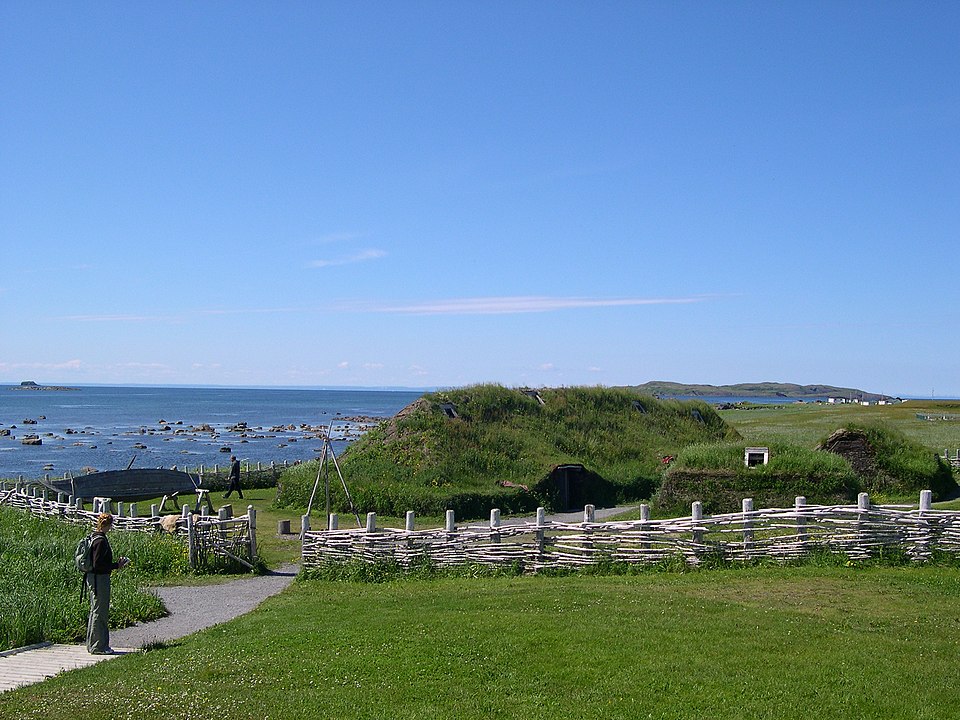
We are right to be wary of two sagas published 200 years after Erikson’s expedition. Fortunately, we do not have to rely on legend alone. At the site of L’Anse aux Meadows, Norwegian archaeologists Helga and Anne-Stine Ingstad found all of the proof we need in the 1960s.
L’Anse aux Meadows is situated on the coast of Newfoundland, Canada. During a dig, the husband-wife team of archaeologists discovered Norse style buildings and iron nails. Carbon dating linked the findings to Leif Erikson’s era. Almost a millennium after the Norse set foot on the continent, Vinland had finally been rediscovered.
Why don’t Canadians speak Norwegian?
Given the precedent that would be set by future European settlers, it is natural to wonder why the Vikings did not remain in Vinland. The land was seemingly teeming with natural resources and there was ample room to continue West if they so chose.
No first hand account provides a definitive answer; however, historians do have several intriguing theories. The sagas mention a conflict with native peoples known as the Skrælings. It is possible that the meager force sent across the Atlantic was ill-prepared for sustained conflict.
Another theory is that Viking commitment to Greenland outweighed their expeditionary ambitions. 10th century Greenland was declining, and explorers may have simply been called home to reinforce efforts there. The isolation of 10th century North America could not have been comfortable for even those as hardened as the Vikings, making a return voyage a welcome prospect.
So what?
Leif Erikson’s expedition provides a necessary challenge to the Eurocentric view that has long dominated the story of North American discovery. The sagas were only widely proliferated in Greenland and Iceland and by the time of Columbus the Viking presence there had nearly collapsed. When Columbus set foot in North America, he was, in effect, 500 years late – though likely unaware of it.
In the 17th century, the sagas resurfaced in European manuscripts, revealing for the first time what a small band of Scandinavian nomads were able to accomplish. While we cannot know the exact reaction, it is reasonable to imagine the revelation dealt a quiet blow to the prevailing self-assurance of Europe’s ruling powers.
 QuillAndQuery
Leave a comment