
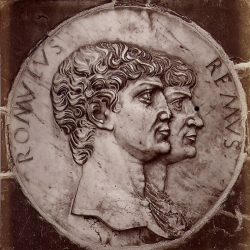
Rome is such a staple of modern history that it is hard for us to fathom its humble origins. Don’t be dejected by this. It’s not just us middling plebeians who have a hard time with this concept. Even our most learned historians struggle to accurately pin down exactly how or why Rome became the powerhouse that we know and love to study today. If you’ll indulge me, I’d like to take you down a wild oversimplification of the journey of a small city on the River Tiber that eventually took the whole Western and Middle Eastern World by storm. It all started with a man named Romulus….
Romulus & Remus
Or should I say a baby? Romulus was born to uncertain parents sometime between 1000 and 700 BCE (ancient Roman timelines are anything but precise). If the Roman historian Livy is to be trusted (and we have several reasons not to trust him) he was the son of the God Mars and a local woman named Rhea Silvia. Due to a struggle between their grandfather and his brother, their mother was imprisoned and Romulus, along with his twin brother, Remus were set alongside the River Tiber intended to be swept away as the river rose.
The Roman Gods had plans for young Romulus and Remus it seemed. As the legend goes, they were picked up from the river and nursed by a local wolf. As absurd as it seems, the legend was taken as fact by most ancient Romans for centuries. The hut where Romulus had supposedly grown up was a legendary holy and historical site, with historical records mentioning it until 78 CE.
The brothers grew up and eventually gained enough influence to restore their grandfather to the throne of the neighboring civilization of Alba Longa by luring his treacherous brother into an ambush. Now solidified as princes, they set out to build a city of their own.
The two brothers disagreed on the site for the city due to wildly varied interpretations of omens from the Gods. For reasons unknown, this conflict boiled hot enough for Romulus to kill his brother Remus, leaving him as the sole claimant to the throne of their new city and total control over where to found it.
King Romulus
How exactly the small city founded by Romulus began to grow is unknown. Livy would have us believe that alliances with local tribes under Romulus’ leadership fortified the city into a local powerhouse. These alliances, along with the good favor of the Roman Gods set the stage for a new civilization to blossom.
One of the early challenges of the city came with that of reproduction. The city was largely founded by groups of outlaws and bandits, down on their luck in the aftermath of the Trojan War. This left few women in Rome to sufficiently grow the population. Fortunately, Romulus had an effective yet brutal solution. The Romans invited their neighbors to a festival hosted in the city itself. When Romulus gave the signal, the Roman men grabbed the women in attendance and took them as their wives. This became known as the “Rape of the Sabine Women.”
Understandably, the neighboring cities were enraged by this brass act of betrayal and began marching their armies for war against the Romans. Had they combined their forces, you may not be reading this article today and Rome may be some historical footnote only mentioned by the most strung out of grad school students. Instead, the warring factions decided to go it alone. Caenina was first to attack. Rome swiftly defeated the onslaught and took the city for their own.
Knowing that more was coming, Romulus prayed to the God Apollo, swearing to build a temple in his honor if the Romans would stay and fight to defeat their enemies. The Gods decided in his favor and Rome fended off its enemies, emerging victorious. Several of the families of the Sabine women were granted Roman citizenship in the aftermath. This would prove to be a convenient bit of foreshadowing of how Rome would subjugate future civilizations centuries later.
Rome continued to live under the monarchy for centuries. Romulus served as king until his death. How he died is not known for sure. Some claim that he was murdered by the senate. Others that he was swept away in a storm. Livy claims that he was simply called away by the God Mars.
So what really happened?
The origins of ancient Rome are frustratingly vague and our only sources are woefully biased in their interpretations. Even the name Romulus may be misleading, given that its modern meaning would be something akin to “Mr. Rome”. What we know for sure is that Rome came from humble origins and expanded through violence and subjugation. The true Roman Republic that birthed the likes of Caesar and Cicero would not form for centuries after the events described here. Those are stories for another time.
 QuillAndQuery
Leave a comment