
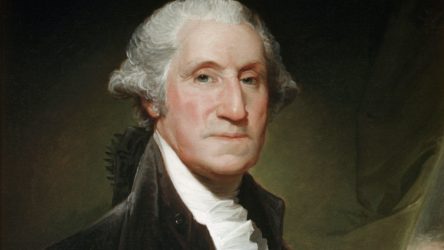
The term “General of the Armies” is not often mentioned, even in United States military circles. Also known as the “Six Star General”, only three people have ever been awarded the title. General John J. Pershing is notable for being the only person to ever live to see himself awarded the honor. Civil War titan General Ulysses S. Grant was awarded the title posthumously for his service against the Confederacy (and we can be sure he would rather be remembered for that than his abysmal record as President). Ironically, the last person to earn the “Sixth Star” was none other than the founder of our nation, General George Washington. In 1976, the congress under President Gerald Ford passed a joint resolution to award the title to his distant predecessor as part of the nation’s bicentennial celebration. It came only 200 years too late.
Washington’s accomplishments as General of the Continental Armies are well known, but who was Washington before the war? His beginnings are surprisingly humble, albeit a bit privileged. Filled with failure, frustration, and strife, his early military career betrays little of the Goliath of American history he would become.
Colonial, but not British
Before he became conveniently aware of British oppression, Washington was about as ardent a British loyalist as they come. Serving as a colonial officer in the Virginia Militia, he had but one goal in mind: earn a royal commission in the regular British army. British colonial officers were looked down upon by their cohorts across the Atlantic and Washington craved the prestige and status that came with a royal commission.
Opportunity presented itself to Washington in the form of tensions with the French over control of the Ohio River Valley. The British and the French were locked into a low-intensity Cold War of sorts over the region, rapidly building forts in the valley in an effort to build legitimacy to their individual claims of territory with ill defined borders. Importantly, these tensions generally stopped short of armed conflict.
As second-in-command to a 300 strong regiment of the militia, Washington received orders to complicate the French advance at the Forks of the Ohio, near present day Pittsburgh, Pennsylvania. It is here where Washington began his first military campaign.
Jumonville
Washington and his army arrived in the Ohio River Valley in February 1754 and began construction on a fort to house and defend his forces. During the construction, Washington was informed by his Indian allies of a small detachment of 50 Frenchmen, part of a much larger estimated force of 1,000 who were constructing the nearby Fort Duquesne. Believing the French a threat to his mission and with valor on his mind, Washington decided his moment was upon him.
He launched an ambush on the detachment and to his immediate observation we can be sure it seemed quite successful. As Washington would later recount in a letter to his brother, “I heard the bullets whistle, and, believe me, there was something charming in the sound.” He easily defeated the small encampment and established the prowess of the fighting force under his command. Unbeknownst to Washington, among those he killed was the French commander Joseph Coulon de Jumonville, for whom the battle would later be named.
An error in hindsight
As it would turn out, Jumonville was serving a dual purpose as military commander and political envoy. At the time of his death, he was carrying a diplomatic message for the British, warning them they were encroaching on French territory and ordering them out of the Ohio River Valley. It is unlikely that the British would have complied with this order, but nonetheless, Washington had killed a French diplomat who likely meant neither him nor his troops any harm.
Washington expected French retaliation and retreated to nearby Fort Necessity where he awaited reinforcement. The fort was woefully unprepared for a French onslaught, a fact famously ignored by Washington. To his eyes the fort could, “withstand the attack of 500 Indians.” Ironically, it was the Indians who Washington was counting on.
The Half King Tanacharison had assisted Washington at Jumonville, but withdrew his troops from British support during the retreat to Necessity. Washington’s misstep at Jumonville had killed the remaining faith Tanacharison had in the British cause. The irony was certainly not lost on Washington given it was Tanacharison’s scouts who informed him of the French encampment to begin with. He was now left only with his small regiment and a meager reinforcement of 200 Virginians and 100 South Carolinians.
Necessity
Unaware of what Washington’s actions would bring, the Governor of Virginia promoted Washington to Colonel for his “success” at Jumonville and gave him full command of the regiment. Time ticked by as Washington waited for his first chance at combat with his new command.
Eventually, the inevitable happened, the French came with a force 700 strong, encircling the fort and blocking off all potential resupply. Washington was faced with no option but surrender. It was Washington himself who reluctantly signed the surrender documents, admitting to the killing of Jumonville and banning his troops from the Ohio River Valley for one year.
Casualty or assassination?
The surrender documents were in French, and Washington had a poor translator. As he would soon learn, he did not admit to simply killing Jumonville but to his assassination. The matter of semantics would prove important, as the French in Europe were enraged by this seemingly wildly escalatory attack.
Hurt feelings would eventually boil over into what would be known as the Seven Year War or as it would be taught in American textbooks, the French-Indian War. The British publicly defended Washington but chastised him in private. He was accused of being careless and foolish in his command. In typical 18th century fashion, his punishment came from a reduction in status. When offered a captaincy on his next assignment, he declined the demotion and resigned his commission in the militia.
He would volunteer as an aide to Major General Edward Braddock and his heroics in his new assignment would rehabilitate his image some, but he would never achieve the royal commission he so coveted. His resentment against the royal British festered, and he would carry that resentment all the way to the Virginia House of Burgesses.
What could have been
It’s hard to imagine a revolution without General Washington, but had the British gave him the career he imagined we very well may have gotten just that. He was by no means the only voice for independence in pre-revolutionary America (nor was he the loudest) but had he not been scoffed at by his British comrades, we do have to wonder whether the likes of Nathanael Greene could have done the job with the same vigor.
Luckily, we’ll never know. Washington took a different path. His early failures would be eclipsed by his monumental successes in the fight for independence, but those are a story for a different day and a better author.


Leave a Reply